


What anti-corrosion treatments are available to protect a heat exchanger?
Corrosion can rapidly impair the performance and service life of a heat exchanger, particularly when the equipment is exposed to a damp, saline, industrial or chemically aggressive environment.
To help customers choose the most suitable protection, TRIANON ÉCHANGEUR has developed a comprehensive page dedicated to surface treatments for heat exchangers, as well as several technical pages outlining the main solutions available.
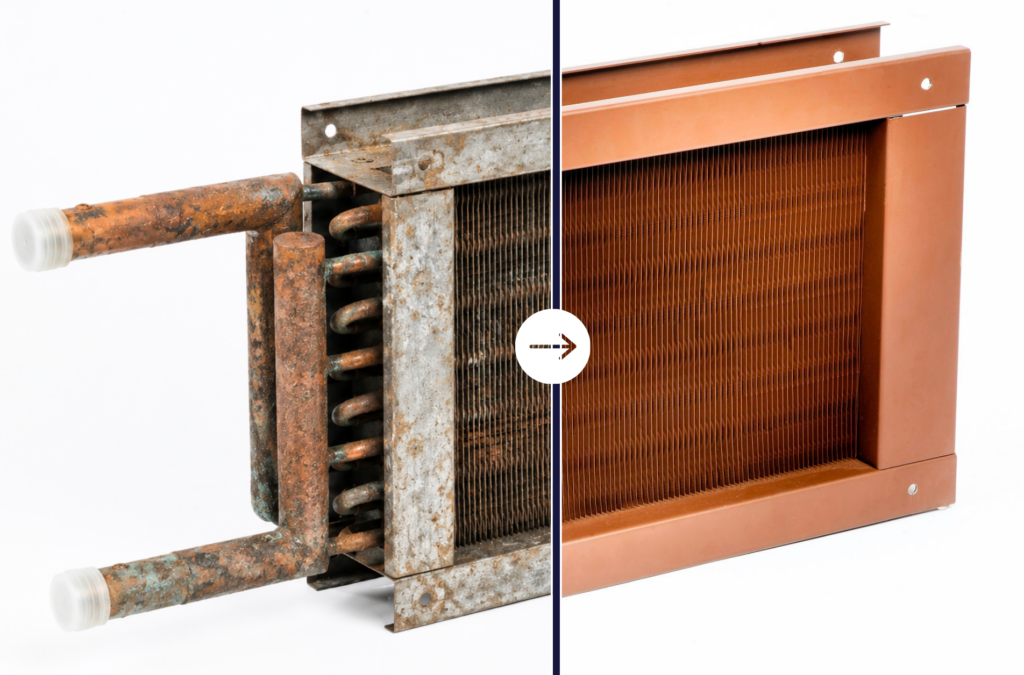
Why apply a surface treatment to a heat exchanger?
Depending on its environment and operating conditions, a heat exchanger may be subject to various forms of corrosion that can affect the tubes, fins, headers or even the frame.
Key risk factors include:
- a saline atmosphere or coastal environment;
- high humidity and condensation;
- harsh industrial environment;
- the presence of chemical substances or fluids;
- significant temperature constraints;
- operating conditions requiring enhanced protection.
In the long term, corrosion can lead to surface degradation, reduced thermal performance and increased maintenance requirements.
Choosing a suitable surface treatment helps to enhance the protection of the heat exchanger and extend its service life.
Our dedicated page outlines the various criteria to consider and the solutions that may be suitable for your application.
Five anti-corrosion treatments explained in detail
To complement this resource, we have created a number of technical pages providing more detailed information on the characteristics and applications of each technology.
The Hérésite treatment involves the application of a coating based on thermally polymerised phenolic resins. It is used in particular to enhance the protection of heat exchangers installed in corrosive or chemically aggressive environments.
Thermoguard is a water-based epoxy coating, developed to protect heat exchangers exposed to harsh industrial or saline environments.
The Blygold treatment is particularly used to protect batteries and finned heat exchangers against corrosion. It is particularly suitable for outdoor installations, in industrial environments or in locations close to a marine atmosphere.
Cataphoresis is an immersion electroplating process that produces a uniform coating, even on certain complex geometries and hard-to-reach areas.
SÄKAPHEN treatments utilise coatings based on thermosetting phenolic resins. They are designed for industrial applications subject to significant chemical stresses and certain particularly demanding environments.
Which treatment should you choose for your heat exchanger?
The choice depends directly on the actual conditions under which the equipment is used:
- nature of the fluids;
- heat exchanger materials;
- operating temperatures;
- humidity level;
- exposure to salts or chemicals;
- indoor or outdoor environment;
- cleaning and maintenance requirements.
There is therefore no single treatment suitable for all applications.
To compare the various solutions and identify the key selection criteria, we have compiled all this information on our main page dedicated to surface treatments for heat exchangers.