


FAQ – Heat exchangers
How can industrial waste heat be recovered?
How can industrial waste heat be recovered?
Industrial waste heat refers to thermal energy produced by a process but not utilised by the plant. It is often discharged into the air, flue gases, condensate, hot water, cooling circuits or certain process fluids.
Recovering this heat makes it possible to reuse energy that is already available on site to preheat air, heat water, power a process or improve the overall energy efficiency of an industrial plant.
Trianon Échangeur designs bespoke heat exchangers and heat recovery units to make the most of this available energy. Each project is assessed taking into account the heat source, temperatures, flow rates, fluids, the environment, permissible pressure drops, and constraints relating to fouling, corrosion and integration.
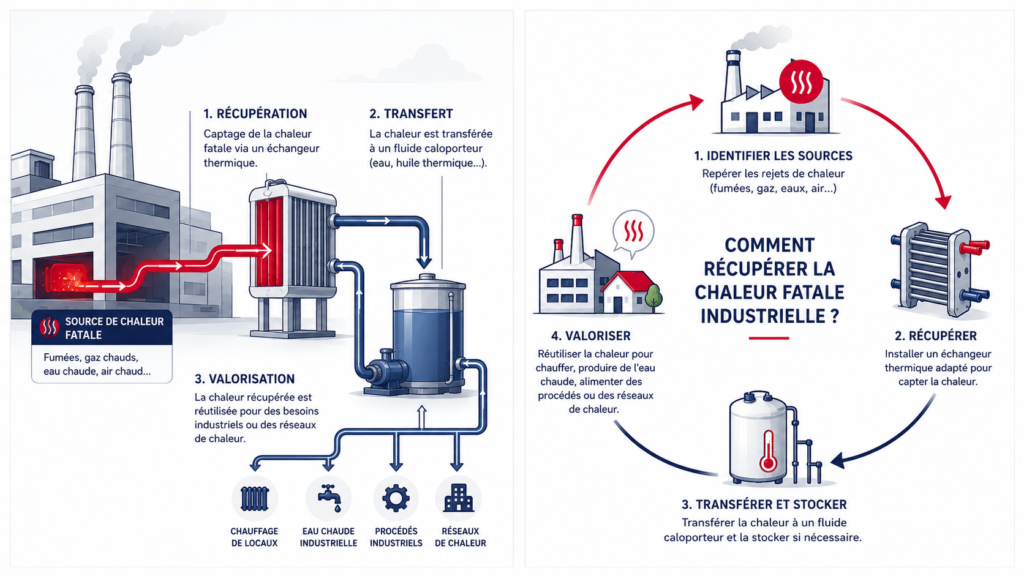
What is industrial waste heat?
Waste heat is heat generated by an industrial process but not directly utilised by the plant. It may originate from a furnace, a dryer, a boiler, a generator, an air-handling unit, a cooling circuit or a thermal process.
It is described as ‘fatal’ because it is produced as a result of the normal operation of the process. Without a recovery solution, it is simply discharged and lost.
The main sources of waste heat are:
- industrial fumes
- the extracted hot air
- steam
- condensate
- hot process water
- cooling circuits
- hot gases
- heat emissions from industrial machinery
The aim is to capture this heat and then transfer it to a fluid that can be used within the system.
Why recover waste heat ?
Waste heat recovery helps to reduce energy consumption by reusing heat already generated by the industrial site.
It can help to:
- preheat fresh air
- to heat water or a process fluid
- to reduce the need for additional energy
- to improve the energy efficiency of a facility
- to minimise heat lossvvvv
- reduce operating costs
- to play a part in an industrial decarbonisation initiative
- to make use of energy that would otherwise be wasted
For a manufacturer, the benefits are energy-related, economic and technical. A properly sized solution can improve the overall performance of the plant without making any major changes to the existing process.
Step 1: Identify the available heat source
The first step is to identify where the recoverable heat is located.
We need to analyse:
- the nature of the hot fluid
- its temperature
- its flow rate
- its availability over time
- its composition
- its moisture content
- its pressure
- the extent of fouling
- its location within the installation
- access and maintenance constraints
A continuous heat source is often easier to utilise than an intermittent one. However, each project must be assessed on the basis of the site’s actual operating conditions.
Step 2: determine how the recovered heat will be used
Heat recovery is only worthwhile if this energy can be put to good use on site.
The recovered heat can be used for:
- preheat fresh air
- to heat a process air stream
- to heat water
- to preheat a fluid prior to a production stage
- charge a hot battery
- reduce an existing energy top-up
- to improve a heat recovery system
The choice of application depends on the available temperature, the heating requirement and the compatibility between the heat source and the fluid to be heated.
The closer the source temperature is to the required temperature, the more suitable the solution may be.
Step 3: Choose the right recovery technology
The choice of heat recovery unit depends on the fluids involved and the system’s constraints.
- Recovery from industrial fumes
A flue gas heat recovery unit captures the energy contained in hot gases from a furnace, boiler, dryer, generator or other thermal equipment.
This type of project requires a careful analysis of flue gas temperature, composition, fouling, corrosion, condensate and permissible pressure drops.
- Heat recovery from extracted air
An air-to-air heat exchanger or a heat recovery coil can be used to recover the energy contained in extracted air or waste heat.
This solution may be suitable for industrial ventilation, air-handling, drying or process installations that generate a usable flow of hot air.
- Steam or condensate recovery
In some plants, steam or condensate represents a significant source of recoverable energy.
A suitable heat exchanger can be used to recover some of this energy to preheat a fluid, reduce the need for additional energy, or improve the overall efficiency of the system.
- Recovery from process fluid
Some industrial fluids emerge from a process at a temperature that can still be utilised. A fluid-to-fluid heat exchanger can then be considered to transfer this heat to another circuit.
La compatibilité des fluides, la pression, la température, l’encrassement et la maintenance doivent être pris en compte dès le dimensionnement.
Trianon Échangeur solutions for recovering waste heat
Trianon Échangeur supports manufacturers, installers, operators and engineering firms with their industrial heat recovery projects.
Selon les besoins, plusieurs solutions peuvent être étudiées :
- flue gas heat recovery unit
- air-to-air heat exchanger
- air-to-water heat exchanger
- air-flue gas heat exchanger
- fluid-to-fluid heat exchanger
- recycled battery
- bespoke finned heat exchanger
- heat exchanger for steam or condensate
- replacement or modification of existing equipment
Our design office analyses the project data to propose a solution tailored to the constraints
actual parameters: temperatures, flow rates, fluids, power, pressure drops, space requirements, fouling, corrosion and maintenance.
The aim is to design an efficient, sustainable heating solution that can be integrated into the existing system.
Which sectors are affected?
Waste heat recovery can be applied across a wide range of industrial sectors:
- food and drink industry
- chemistry
- pharmacy
- cosmetics
- industrial air treatment
- drying
- energy
- data centers
- automotive
- timber and sawmill
- building services
- high-temperature process
Each sector has its own constraints: hygiene, corrosion, dust, temperature, accessibility, production continuity or regulatory requirements.

Need to look into a heat recovery project?
Do you have an untapped heat source at your site?
Trianon Échangeur can analyse your requirements and develop a heat recovery solution tailored to your industrial process. Please send us your operating data, drawings, photographs or installation constraints so that our design office can assess the technical feasibility of the project.